
Broken Bones and Cookies

Well, I was going to write an elaborate and fascinating post on used bookstores.

Hopefully I still will, at some point. But not today. I’ve got something else on my mind.

Chocolate chip cookies.

Free image courtesy of Stock.xchng and superfloss

I usually have chocolate chip cookies on the brain in some form or other. Warm on a napkin, with the chocolate just a little bit melty, they make my shoulders unclench any time of day. I’m an absentminded baker who tends to calculate quantities wrong, but for these cookies, I try harder to get them right. They were one of the American delicacies I missed most in Britain. But now they’re on my mind for a different reason.

It was Wednesday night, a hard night, a gloomy night. An odometer-raising, package-juggling, asparagus-and-tears-for-dinner night. Grandma’s not doing well, and the pressure had me full under its thumb that night. I was supposed to meet a friend for coffee, but though I love talking to her, I just didn’t want to on Wednesday. I didn’t want to talk. I wanted to sit and watch British TV until my mind melted into oblivion. I texted her.

She came anyway. Showed up on my doorstep, skipped coffee. Carried in her hands a green recyclable grocery bag. Containing chocolate chip cookies.

People say all kinds of things to friends who are hurting. Sometimes they’re well-meaning things like Every cloud has a silver lining. Or God works out everything for the good of those who love him. Maybe they’re true things. But when the wave of suffering knocks you over from behind and tumbles you on the sand until your skin is scraped raw and you can’t remember which way is up, even true things don’t help.

Free image courtesy of stock.xchng and storm11080

Suffering is a quiet place, a place where the rules don’t work right and you have to reinvent the wheel. Like falling in love, it’s a different experience for every person, and it feels like no one has ever experienced it before. That’s why platitudes, no matter how true, don’t help. They’re words. And while I love words dearly, you can’t use them to set a shattered arm or leg. Like sticky, cheerful Disney-character band-aids, they’re utterly helpless to solve the mystery and horror of bone sticking through skin.

My friend couldn’t fix my problems on Wednesday night. She didn’t try. Instead, she listened with her full attention (I did end up talking) and gave me a hug (thank you, dear). The chocolate chip cookies she brought said I don’t have all the answers. But I love you anyway. And somewhere between soggy Kleenex and melty chocolate pieces, I found the strength to keep going til tomorrow. That’s what helps.

Lately music has been helping me where words fall short. So if you’re in that quiet place tonight, reinventing the wheel or staring at shattered bone, here’s a song that another friend showed me today. It’s not a solution. But maybe it’ll be like chocolate chip cookies on your doorstep.

Haute Couture

You can start laughing now.

If you’re not laughing yet, realize that fashion is never a word that has belonged in the same sentence with my name. Maybe I would be at the height of it if I walked into a medieval castle, a Civil War ballroom, or a British tea party–but as for the fashions of today, I’ve been chronically clueless since I was old enough to dress myself.

That’s not to say I don’t like to look good in my clothes. Or that I don’t have a sense of taste (however eclectic it may be). But I’d consider that more “personal style,” a notion of what I like and what looks good on me, than an awareness of what Parisian designers are sending down the runways this season.

However, in the last few months, fashion hasn’t been as far away from me as in the past. For one, my mom and I have been faithfully following a BBC show from the ’90s, The House of Eliott, which follows a pair of sisters who start their own fashion house in 1920s London. Besides having a great story with compelling characters, the show’s costumes are gogglingly gorgeous. And as I learn more about sewing and design, it helps me to better understand an industry that once seemed mysterious and ridiculous.

Beatrice and Evangeline Eliott, protagonists of  The House of Eliott

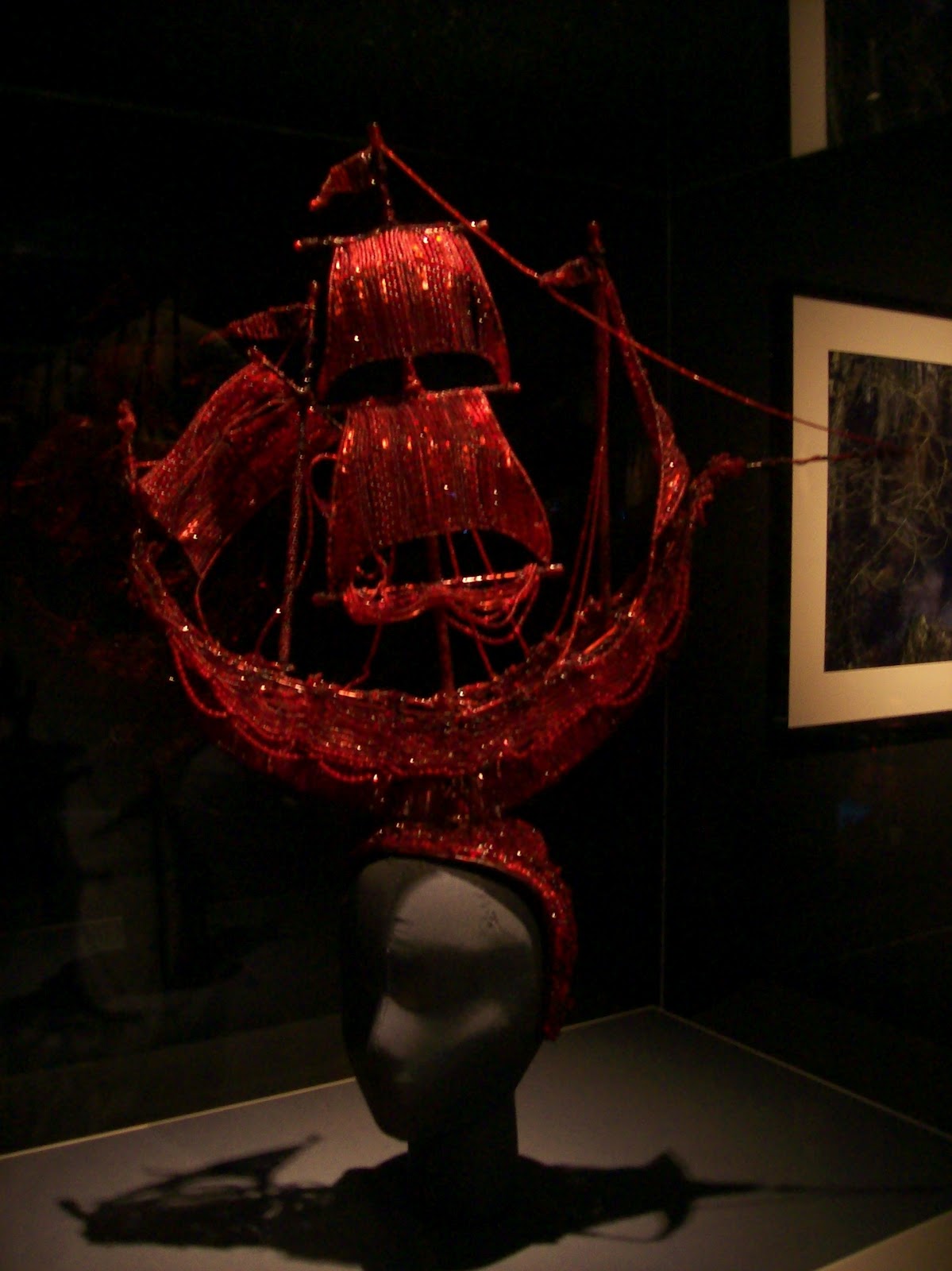
Last month I also went with my grandparents to a San Francisco museum exhibition of fashion by Jean Paul Gaultier in San Francisco. Though Gaultier is known as the enfant terrible of French fashion and I would never actually wear any of the outfits I saw on display, it was a fascinating glimpse into fashion as an art and science. The very name haute couture (French, of course) means “high sewing.”

Gaultier fashions on mannequins with moving faces!

In addition to the costumes themselves (displayed on mannequins with moving faces!), there was a documentary tracking the last 48 hours leading up to a Gaultier fashion show. Backstage, away from all the paparazzi cameras and snobbish facial expressions, was a busy hive of incredibly talented seamstresses who specialized in turning one man’s eye for whimsy into precise creations of stitches and sequins. Every garment for a fashion show is made completely by hand, some of them representing 200 man-hours or more.

A galleon headdress made entirely out of red beads

There’s also an enormous amount of creativity involved. Again, while I didn’t see any of the garments as really wearable for myself, conceptually I found them very interesting. Gaultier experimented with unexpected materials and combinations: artificial crocodile skin and crochet, knit and tulle, gold lame and seashells, leather and feathers, even human hair. He also chose themes for his fashion shows that tickled my fancy as a writer: mermaids, madonnas, even human body systems.

So, while you may never catch a glimpse of high fashion in my wardrobe, I have gained some respect for the field as a creative art and a highly skilled craft. I do prefer wearing my personal style, though. It’s my humble opinion that people always look best wearing what suits them, rather than whatever happens to be trending at the moment.

And now I pass the fashion-commentary baton to those more qualified. For further reading, check out this mash-up:

Bear Ears: original knit designs and patterns
Cafes and Closets: vintage and gothic style blog
Adelle Gabrielson: shoe love
Fashion from Literature: modern-day outfits for literary characters
My Disney Fashion Dreams: Disney-character-inspired fashion collages

What are your thoughts on fashion, style, and haute couture? 


What Car Shopping Taught Me about Relationships

Here’s an unusual factoid about me: I’ve never had a boyfriend. Yes, you heard me right, 5th-grade girls from summer camp. It IS possible to pass the age of 18 without hunting boys for sport. Promise.

But though I may not have much experience in the area of romantic relationships, it doesn’t mean I don’t know anything about them. Sometimes a 3rd-party perspective is the most credible, and I certainly have a degree of objectivity. So I’d like to share some things I’ve learned about relationships…from the process of buying a car.

Free image courtesy of stock.exchange

What do a car and a potential marriage partner have in common, you ask? One is a high-tech metal machine that takes you places, while the other is a human being, full of opinions and dreams, with whom you will spend the rest of your life learning to meld. But both cars and lifelong relationships are huge decisions. And most involved decision-making processes have things in common. So as I was learning about transmission fluid and PSI, the writer in me was noticing things that could be cross-applied.

So here are the results:

    1. Don’t start test-driving until you’re actually in the market to buy. 

    Though I’d saved enough money to buy a car long before this year, I decided not to start shopping until I knew I had the income to support it (insurance, gas, maintenance, etc.). Now I’m glad I did–because once I put my hands on Baby’s wheel, I was so dazzled that it would have been hard to let go, even if I’d been financially unready for her. You kind of have to stay away from Craigslist entirely until you’re ready for the possibility that you might buy a car. I think the same goes for dating and marriage. Yes, my dear 11-year-olds–I’m talking to you. Not in the market to buy, don’t start shopping. 


    2. Get plenty of advice from plenty of sources–especially some with credibility. 

    From the adult friend who coached me on used-car salesmanship techniques to my cousin who listened for rattles in the engine to the fellow Corolla driver who proudly declared that the trunk was large enough to fit 2 bodies…I got lots of advice before making my decision. Almost everyone over 16 has a story about buying, or at least driving, a car. No one person has all the answers, but by talking to lots of people, I got a big picture of some do’s and don’ts. Most helpful of all was the advice of my mechanic, a man who has made car health his profession for decades. When I got the go-ahead from him, I knew I could rest easy about buying this car. Similarly, when considering the possibility of a relationship, it seems sound to get all the input and advice you can, especially from those who are experienced judges of character. 

    3. Know the flaws you’re buying. 

    One of the people I asked for advice told me, “When you buy a used car, you’re buying somebody else’s problems.” Since I didn’t want to end up stranded on a highway somewhere, from the moment I saw Baby, I started to look for what those problems might be. Sure, it made me feel like a cynic as I cranked all the knobs, pushed all the buttons, and  made sudden sharp turns, but I didn’t want to rush into a purchase only to regret it later. Baby (even I will admit) isn’t perfect, but her flaws are mostly minor and cosmetic. I can live with those things, knowing I can rely on her to take me places reliably and safely. Likewise, evaluating a potential mate thoroughly at first can help prevent breakdowns on the highway later.

    4. Take time to make your decision. 

    Since Baby used to be a rental car, the company let me rent her for the weekend to do an “extended test drive.” Lesson learned: extended test drives are really, really good. I had time to discover Baby’s strengths and weaknesses, imagine myself driving her everywhere, and sleep on the decision before entering negotiations. I loved not being rushed or put on the spot. And I’ve had almost no buyers’ remorse. If taking time to make a wise decision is so important for a car that will last 8-10 years, how much more important is it for a marriage that will last a lifetime! 


    5. Sometimes you do buy the first car you test-drive. 

    People told me to expect to drive 10-12 used cars before finding “the one,” and to be ready to walk away if a car wasn’t right. I was ready to walk away. I honestly didn’t expect to find the ideal car the first time I called about a Craigslist ad. But all my prerequisites were in place: I was in a position to buy, I had lots of advice, and thanks to the extended test drive, I had a pretty good idea of what flaws I was facing. So when the first car that zipped into my life turned out to be perfect for me, I was ready to make an offer. It felt weird that I hadn’t experienced more options, but I know I would have been crazy to turn Baby down. Maybe it’s not necessarily about how many people you date, but about being ready when the right one comes along.

    Free image courtesy of Salvatore Vuono and Freedigitalphotos.net


    First Rain

    On Wednesday morning, September 5th, it rained.

    All right, laugh, my friends in the Pacific Northwest. Here in California, it doesn’t just rain all the time. It isn’t something to be taken for granted. And not just if you work for the Water Department.

    This morning’s rain only lasted a few minutes, just barely wet the ground, but it was special. Have you ever really watched it rain before? It’s magical.

    It’s the first silver puddles of the season.

    It’s dusty dribbles on Baby’s windshield that make me glad I didn’t wash her yesterday.

    It’s dark thunderheads gilded with bright edges by a sun that’s there, but that you can’t see.

    It’s sharp contrasts in the sky and wet asphalt on the ground.

    It’s a fine veil sewn all over with silver stitches.

    It’s an eager rustle, like the crinkle of a safe blanket coming up to your chin, like the whisper of a fairy godmother’s skirts.

    It’s a soft, growing smell, a smell of motion and of rising, a halfway dusty smell, like the pages of an old book.

    And it’s a cool breeze blowing through your house, straight through open windows, sweeping away the stagnant heat of a long, hot summer. It’s ushering in something new, an anticipation of what may be.


    Fall is just around the corner! What do you look forward to about this new season?


    Blogiversary

    This Saturday, September 1st, marks a very special occasion.

    It’s my first blogiversary!

    Twelve months of blogging, oh my. It gives me cause to look back and trace the journey.

    Image courtesy of FreeDigitalPhotos.net and Anusorn P. Nachol

    Twelve months ago, I was fresh out of college, sitting down at my computer to start a career as a freelance writer/editor. I was finishing up the messy first draft of a 100,000-word children’s novel. Since then, I’ve picked up work as a tutor in addition to accepting freelance projects. The novel is now in its 3rd draft and is 25,000 words shorter. I’ve made new friends in the blogosphere and learned to use Twitter and Goodreads. In the last 12 eventful, rocky, sometimes nail-biting months, I’ve also learned a few things.

    I remember rewriting my first blog post probably ten times. I was too nervous to share an imperfect work with the world. Now, whether I like it or not, I don’t have time to make each post perfect. Aunt Josephine tries to make sure my content is grammatically error-free, but sometimes my ideas come out half-baked. I guess that’s part of growth–admitting that not everything you do is perfect.

    My first batch of blog posts were mostly academic. I stuck to writing about books, teaching, and the employment crisis of twenty-somethings. I thought I could only contribute what I knew. In December, though, I took a leap of faith and wrote about grieving during the holidays. Since then, a friend pointed out, I’ve invested more of myself into my posts. Books, Reading, and Writing are still some of my biggest labels, but if you read the sidebar, you’ll now notice topics like Caregiving, Conflict, and Singleness joining the repertoire. These posts, while sometimes raw, challenge me to honesty in my writing.

    It’s also nice to get read. While it’s not something I have total control over, it’s nice to know that this blog isn’t a total waste of space on the Internet. Thanks to you, Best Beloved Readers, this blog has gone from 250 readers a month last September, to nearly 1000 this month. Over 8000 people have visited this blog in the last year! That’s exciting to me, and I’m grateful to you for continuing to read faithfully. A writer without readers may become, in Shakespeare’s words, “a tale / told by an idiot, full of sound and fury, / signifying nothing.” (Macbeth V.5)

    Thankfully, that doesn’t appear to be the case. I’ve recently been honored to receive 2 blogging awards: One Lovely Blog and Very Inspiring Blogger. Many thanks to my friend Ellen V. Gregory, an Aussie writer who muses about books, writing, and occasionally cats, for passing them on.

    I was supposed to share 7 things about myself in order to receive this award, but I think reviewing 12 months of blogging kind of covers my bases 🙂

    And now I must nominate 15 other lovely bloggers for these awards. I’m going to break the rules again. I’ll give a shout-out to a few blogs I’ve especially enjoyed reading lately, but if you want to play, leave me a comment! I think you deserve the chance.

    A few good blogs for your perusal:

    Bekah Graham (Word-of-the-Day Toilet Paper), Rabia Gale (Writer at Play), Tami Clayton (Taking Tea in the Kasbah), Angela Wallace (Elemental Magic), and The High Calling (Everyday Conversations about Work, Life, and God).

    Here’s to another twelve months of blogging!

    What have the last 12 months held for you? 

    Roots

    I spent last weekend forgetting what decade I live in.

    My paternal grandparents are very interested in family ancestry, and my grandmother is writing a book on it. Naturally, being the English major of the family, I am the editor (read: Aunt Josephine).

    Family history is an interesting thing. On my mother’s side, I know my heritage is Eastern European, but a few generations back, it becomes impossible to trace the exact lineage. Both of my maternal grandparents had Jewish roots in Hungary, and during World War II, not only were many printed records destroyed, but many living records as well. Several of my Jewish great-uncles disappeared during the war, and it is only too easy to imagine what happened to them. When I walked through the sobering Jewish Museum in Berlin two summers ago, it was like staring into a chilling mirror of an alternate reality. A few decades later, a few different decisions, and it was easy to imagine my own picture on those elegiac walls.

    The Jewish Memorial in Berlin

    Since much of my maternal ancestry is shrouded in history’s fog, my paternal grandmother’s research becomes even more interesting to me. Far from being a dusty chronicle of births, deaths, names, and dates, my grandmother’s book tells the stories of the people who are partly responsible for my existence, as far back as the research goes. I heard stories about my father’s childhood wish for a pet snake, my grandmother’s employment under a chauvinistic Kansas newspaper editor, my great-grandfather’s shocking decision to send his daughters to college, and generations of farmers, pioneers, and immigrants before that.

    My paternal grandmother’s family in 1945. She is standing on the left.

    Being a young person in an individualistic culture can feel like being adrift, an unmoored raft on a lonely sea. Finding out where you come from–who went before you and how they confronted life’s challenges–brings a certain sense of security, of knowing your place in a larger web of people. It’s like belonging to a clan in Scotland’s clan system, or giving directions to a new place based on other familiar landmarks. Learning the stories of family members, even those long gone, helps me to better understand my own story by placing it as a succeeding chapter to theirs.

    Besides, they are irresistibly interesting.

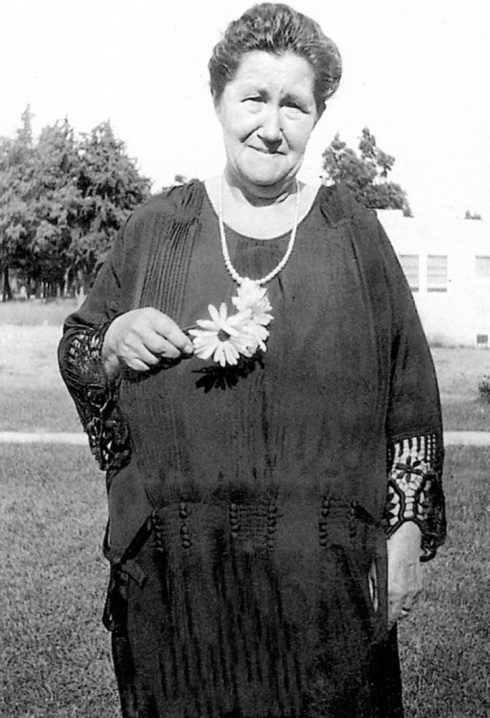
    This is my grandmother’s grandmother, Cora (1856-1952). She grew up as a pioneer girl who lived with a fear of marauding Indians to the very end of her life. In her old age, she loved candy and spoiling her granddaughter, making handmade doll clothes and putting away pretty items for her hope chest. For a section of my childhood, I was convinced that I was Laura Ingalls and went nowhere without my checkered red dress and sunbonnet. I still treasure the doll clothes that my own grandmother made by hand. I wonder if echoes of personality can reverberate across generations. 

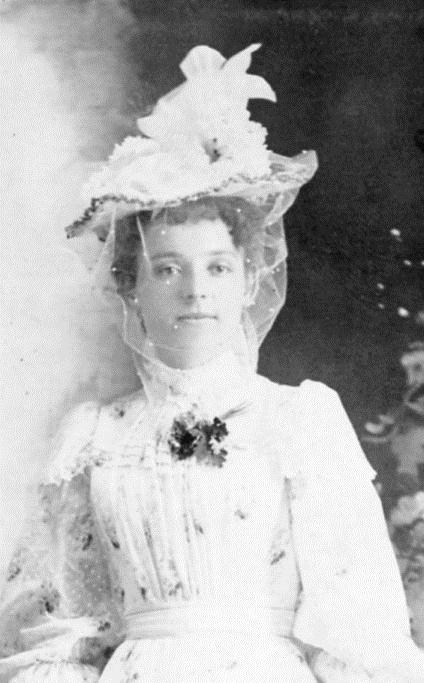
    Great-grandmother Ada (1872-1962) was an educated working woman before the turn of the century. A seamstress by trade, she probably made this dress/hat she is wearing in her wedding photo. Married “late” (age 24!), she was a good listener and loved to read. As a gift, she gave my grandmother a diary which she kept daily through high school. I now have a copy. Perhaps there’s a bit of physical resemblance between us, too?

    It is good to have history. It is good to be a part of something greater than yourself. I am blessed not to be a chapter without a prologue.

    What is your family story? Do you know anything of your roots? 

    Writer/Editor

    My business card says Alina Sayre, Freelance Writer/Editor. 
    It doesn’t say that those two halves of my brain have separate personalities. 
    But before you ship me off to the asylum with multiple personality disorder, I’d like you to meet them. 
    The writer in me is named Cordelia, after Anne from Anne of Green Gables by L.M. Montgomery (played by Megan Follows in the 1985 film). At her first meeting with her new guardian, Marilla, eleven-year-old Anne introduces herself this way:

    “Will you please call me Cordelia?” she said eagerly.
    Call you Cordelia! Is that your name?”
    “No-o-o, it’s not exactly my name, but I would love to be called Cordelia. It’s such a perfectly elegant name.”
    Cordelia is a dreamy, imaginative person with plenty of capacity for feeling and believing. She watches the habits of people and observes the world with eyes hungry for detail. No nook or cranny is too obscure to find wonder there. Sometimes she gets carried away with wild schemes, like dyeing her hair green, or flies into unexpected rampages, but overall she is a poetic and reflective person. She lets beauty “soak into her soul” and makes up stories about herself, her family, the neighbors, and any interestingly unsuspecting person. Consider yourself warned.
    The other half, Madame Editor, is a middle-aged Victorian woman named Aunt Josephine (played by Meryl Streep in the film version of Lemony Snicket’s A Series of Unfortunate Events). Her watchword is:
    “Grammar is the greatest joy in life, don’t you find?”

    Aunt Josephine’s idea of a good time is an afternoon spent adjusting commas in accordance with The Chicago Manual of Style (16th ed., of course). She flinches at the improper use of their/there/they’re and goes into raptures over a sentence that diagrams correctly. Her ideal man is one who says, “Why…grammar is the number one, most important thing in this here world to me” (even if he turns out to be a sham fisherman). 

    How these two people co-exist inside my head is a mystery to me. They certainly don’t get along very well. Both are high-strung and occasionally fly into a temper when their opinion is contradicted. I’ve learned that the key to a happy mental life and successful writing sessions is to keep them apart. Do not cross this line. Do NOT cross this line. 

    When I’m writing, usually Cordelia gets to come out first, because Aunt Josephine isn’t actually very good at coming up with original sentences. Cordelia, by contrast, could gush out words until the moon turns blue. With over 500,000 English words to choose from and an innumerable number of life observations and human subjects to choose from, she can imagine herself into any world she chooses at any time of day. But eventually it’s time for her to come away from the keyboard and give someone else a chance.

    Then Aunt Josephine comes out to play. While she may look like an ogre as she ruthlessly slashes away, cutting out whole words, sentences, and paragraphs, she actually has a huge respect for writing and language. She simply believes that language forfeits its full power if it is overused or improperly used. Brevity is the soul of wit, and good grammar doesn’t hurt either. Sometimes she bosses Cordelia into submission, but when the dust settles, they usually agree that the end manuscript is better for their joint efforts. 

    I saw a cartoon where a pencil point and its eraser were having dinner together. On the phone, the pencil point says, “Can I call you back? I’m having dinner with my editor.” Life in my brain is like that. As long as the two halves of the pencil work separately and respect each other’s abilities, they continue to co-exist safely and (sometimes) happily.


    Does your brain have multiple sides to it? How does it help or hinder your creative process?

    Brave

    My novel’s characters are getting braver. 
    In college, I had a writing professor who continuously told me that my stories needed more conflict, that nothing happened in them. 
    I didn’t tell him that that was because I’m terrified of conflict. 
    Free image courtesy of Stuart Miles/FreeDigitalPhotos.net
    Actually, I’ve spent most of my life tiptoeing around other people’s disappointment. Conceding. Scrambling to deliver. Shying away from honesty about my needs, feelings, and limitations. 
    As I revise my novel, I’m seeing that fear in my characters. In my last draft, they’d get frustrated, feel beaten down, get worked up almost to the point of an argument–and then dodge, preferring to dwell inside the safety of their own heads. 
    Not in this draft. Not as much, anyway.
    In the last month of my life, it seems as if opportunities for conflict have abounded. Mounting stress and limited energy have sometimes left me in a corner, with no choice but to say “no” or crumble. 
    Turns out, though, that “no” can feel pretty good. (This video about “no” makes me laugh.)
    “NO” is one of the hardest words for a people-pleaser to pronounce. WHAT?? I’m NOT Superwoman??!! 
    Guess not.
    People aren’t always going to be happy with me. It’s not always good for me to say yes. It’s not always possible. And that’s OK. Even if it makes people mad on occasion. The people who really matter will stick around, love me even when I’m not perfect.
    And guess what? It’s even OK for me to ask other people for help sometimes, too! Wonders abound. 
    While I was at camp this past week, volunteering as a counselor, I had the chance to walk a prayer labyrinth: an interactive tool for meditation that involves prayer in motion. As my feet walked, one in front of the other, in between the double line of stones, I got such a picture of what it means to set limits. All I can do is walk between my rocks. They’re my boundaries. I can’t control what goes on beyond them. I just need to keep walking in a lane just wide enough for my feet. Those are my limits. And it’s OK to let other people know I have them.
    Touchstone Maze
     © Copyright Carol Walker and licensed for reuse under the Creative Commons License 
    Sometimes that means conflict.
    And conflict…I guess…can actually be a good thing. Admitting that has given me such a boost of confidence.
    I’m still not great at this whole say-no thing. I end up folding a lot more than I’d like to admit. But at least I don’t get nauseous anymore when I’m trying to write an argument scene. Not usually. 
    My characters are learning right along with me to step up and slap conflict in the face rather than tiptoe around it. 
    And here’s a sneak peek at the results. 

    “Can I help too?” Vivian asked eagerly.

    “You?” Captain Daevin laughed. “Help with carpentry? It’s awfully dusty work, and you’re in this charming dress. Leave the men’s work to the men. Don’t fret your pretty head about it; you probably couldn’t follow the calculations anyway.”

    She whirled on him.

    “I beg your pardon? At the Library I was raised to Scholar Sixth Level in half the usual time. I can read in eighteen languages, and I most certainly will not leave this work to the men! What do you think I am; a painting on the wall, existing only to be admired? Thank you, sir, but I have no fear of a little dust, dress or no dress. Here.”

    She thrust her straw hat into his hands and turned her back on him, her face flushed, eyes blazing. 

    “Now, what can I do to help?”

    Slack-jawed, Jude handed her a hammer and a bundle of nails. Captain Daevin, still blinking in surprise, backed out of the room, her hat still in his hands. 

    Turning Down the Heat

    You may wonder where I’ve been this week.

    I’ve been learning to rest. 
    Workaholism, I read somewhere, is a drug just like nicotine or caffeine. It’s a stimulant we use to hide our exhaustion, our depression, our frustration. It keeps us busy so that we don’t have to think about what’s going on below the surface, what’s wrong with our pace of life. 
    But it’s only a temporary fix. The busyness only keeps a lid on life to a certain pressure point. After that, all the junk we’ve been sitting on–anxiety, estrangement, dissatisfaction, disappointment, uncertainty–overflows like a boiling pot of spaghetti that explodes in a sizzling deluge all over the stove. 
    So if overworking, outrunning our problems is only a mask, how do we deal with them? How do we keep our internal pots from boiling over? 
    I still have a lot to learn on this topic, but I took a few days this week to intensively focus on these things. Unlearning old habits is hard, but impending burnout is good motivation. These tips might seem obvious from the outside, but it’s amazing how effective they are when you really put them into practice!
    1. Don’t turn on your computer and cell phone until you’re ready to make contact with the world in the morning. You can’t control the volume of calls and e-mails you receive in a day, but you can set some times that are technology-free. It relieves stress and restores some quiet times of focus.
    2.  Make a new to-do list every day on a separate post-it or paper. Make it detailed, including all the tasks you expect of yourself in one day: Get up. Eat breakfast. Fold laundry. Then enjoy the satisfaction of checking items off and throwing away the list at the end of the day. If you didn’t finish every last thing, it’s OK: you’ll have a fresh one tomorrow. This kept me from feeling disappointed about what I didn’t accomplish during the day and helped me to realize all that I did. (It also kept me from committing to more things than I could fit on one page.) 
    3. Include time for rest in the day. Spend a half-hour or an hour curled up with a book, watching your favorite TV show, taking a nap, or cuddling with pets. I found myself working more energetically, cheerfully, and efficiently during the day when I took a break somewhere in the middle. 
    4.  Don’t sign up for too many things. It’s better to do each activity of your day with enjoyment, margin time, and time to stop and appreciate people than to try and cram 50,000 things into 24 hours. Say no when too many tasks threaten to overwhelm you. 
    5. Surprise your family (or whoever you live with) with little, spontaneous acts of love, affection, and service. Empty the dishwasher. Bring in the garbage cans. Leave encouraging notes. When you have fewer things crammed into your day, it’s easier to find time for this, and it helps reduce your loved ones’ stress load, lifting the overall mood of home. (You’d be surprised how this comes back around, too!)
    What are your secrets for setting boundaries in your life? How have you learned to pace yourself and rest? 
    I’ll be out of town this coming week, so look for my next post on August 6!

    Cleaning Out

    For some reason, summertime always ends up being clean-out time in my life. None of this spring or fall cleaning business. Summer rolls around and I get the instinct to reset my environment, sort through the junk and piles–at least partially.

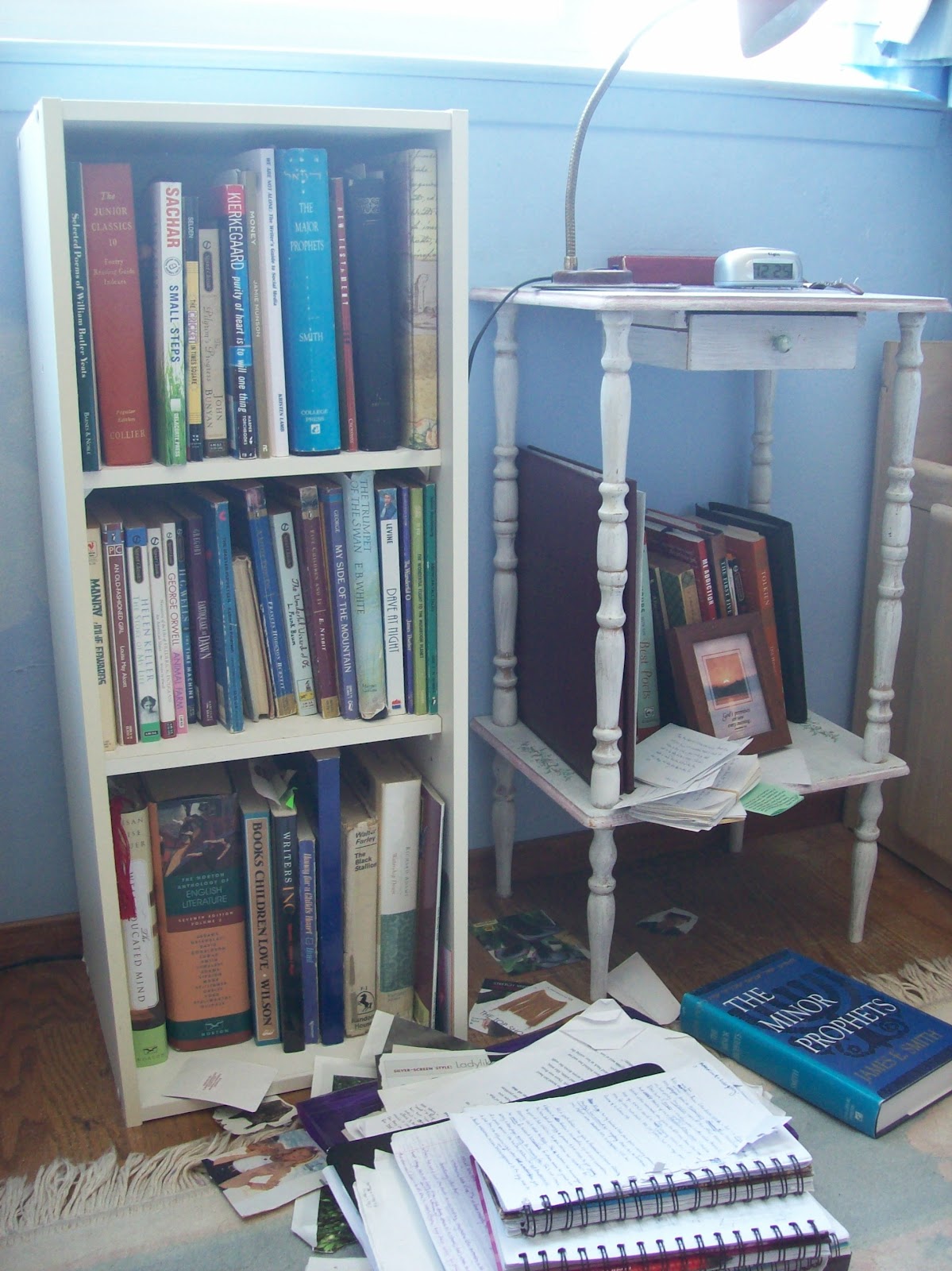
    Some things are hard to clean out, especially books and papers. That’s why my room/office sometimes looks like this:


    I’m a word person, and words are special to me. That means I keep old letters, journals, and books. (Sometimes it also means I have newspaper ads from 5 years ago…)

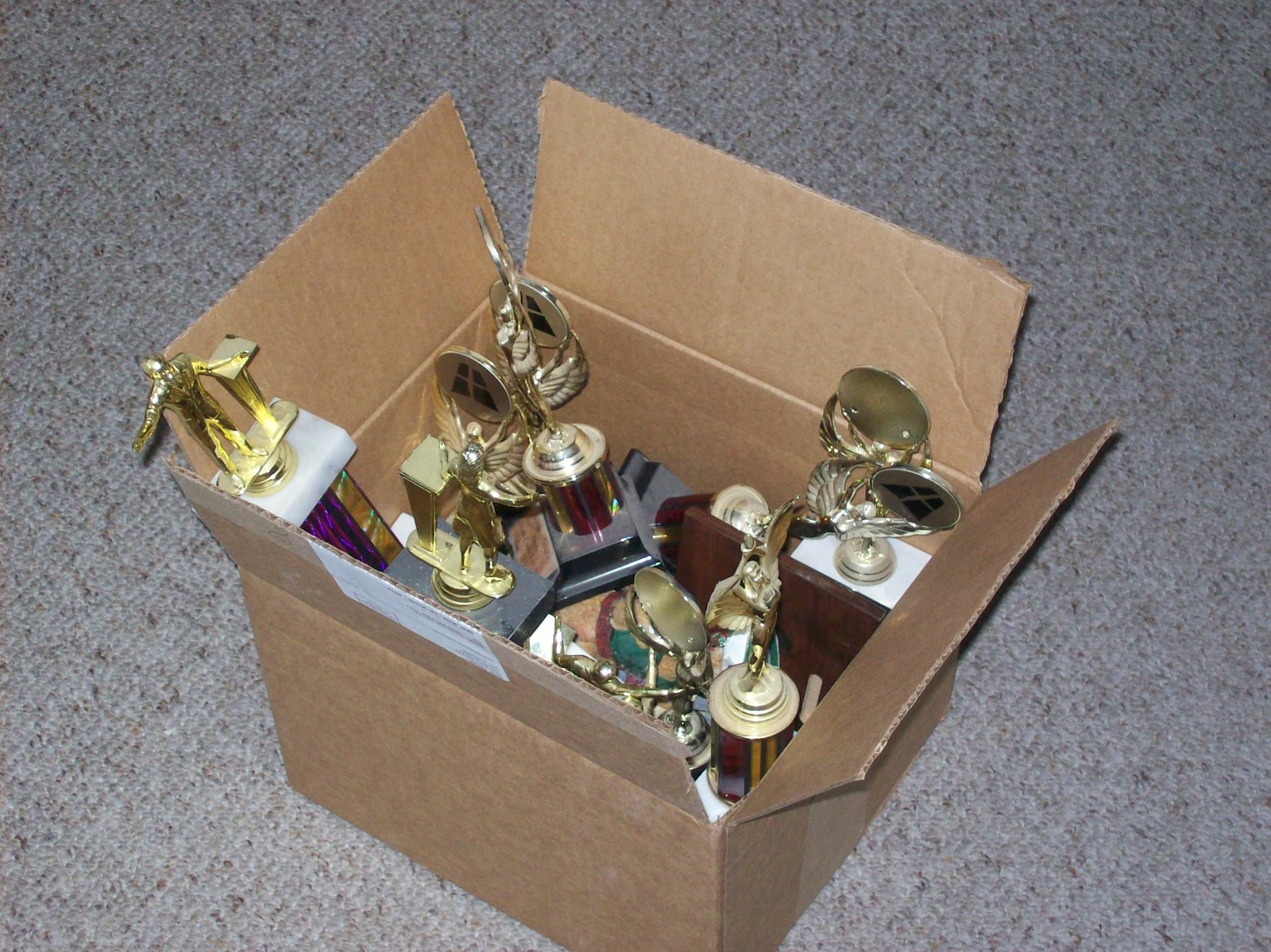
    But there’s one collection of things that I recently found was much easier to throw out than I thought it would be: my high school speech and debate trophies. My mom, eyeing them gathering dust on the shelf, coolly suggested that I look through them. In under ten minutes, most of them had ended up in a cardboard box headed for the garbage.


    I was surprised to feel so little attachment. At those weekend-long speech and debate tournaments, we students lost sleep, skipped meals, battled nerves, developed grudges, and drove hundreds of miles to turn our countless hours of practice into one of these trophies. Shiny affirmations of our excellence, they brought fifteen delicious minutes of fame in front of cheering friends and flashing cameras, plus bragging rights. 

    Six-plus years later, I didn’t remember where most of these trophies came from. When I hustled them off the shelf, they looked just like what they were: plastic and dust. I actually laughed a little at how nervous I used to be, hoping to make it to semifinals, finals, the awards platform. I was suddenly really, really glad that I spent my time in high school working for other things as well: public speaking skills, the practice of giving glory to God, strong friendships. These things remain useful and valuable to me almost every day of my adult life.  

    Of course, I did keep a few trophies–a few pieces of plastic that reminded me of special moments. A First Speaker award from a debate tournament where all the other competitors were pre-law-school boys. A cup from the national tournament where I dragged my giant portfolio of visual aids onto the airplane as my carry-on. A first place trophy from my 18th birthday, where an auditorium full of people surprised me by singing Happy Birthday to me on the awards platform. But I kept them because they’re memories, not because they’re trophies. 


    Anyway, my room still looks like a mess, so I’m signing out. Throwing out trophies just reminded me how much I want to spend my time now working for things that will last, that will still matter even when all the microcosmic stress and work is done. 

    So I’ll cherish the old rugged cross
    ‘Til my trophies at last I lay down
    I will cling to the old rugged cross
    And exchange it someday for a crown.
    ~George Bennard, ‘The Old Rugged Cross,’ 1912